

MedFriendly®














Tapeworm
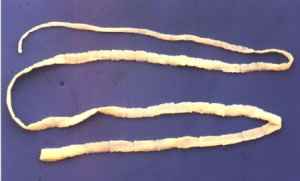
Tapeworms are ribbon-shaped worms that live inside
the intestines of humans or of animals that have a
spine. The intestine is a tube shaped structure that is
part of the digestive tract. It is divided into two parts: the
small and large intestine. The small intestine is a part of
the intestine that takes in all of the nutrients (healthy
substances) that the body needs.
FEATURED BOOK: Tapeworms, Lice, and Prions
The large intestine absorbs moisture from the matter that is left after it is digested in the
small intestine, and excretes the waste from the anus. Excrete means to release from the
body as waste.
Tapeworms are considered parasites. A parasite is any organism that lives in or on
another living being, gains an advantage by doing so, but causes disadvantage to the
being it is living on.
WHAT ARE SOME OTHER CHARACTERISTICS OF TAPEWORMS?
Adult tapeworms have hooks, spiny structures, or suckers on their head, which allow
them to attach to the wall of the intestine. The rest of the tapeworm is made up of a chain
of flat segments. In the human digestive system, tapeworms develop into an adult form
with one or more sexual organs that are capable of producing eggs. Adult tapeworms can
be 20 to 30 feet in length! Tapeworms belong to the class, Cestoda. A class is a category
in which animals (and plants) are organized based on common characteristics they share.
"Where Medical Information is Easy to Understand"™
Tapeworms go through various forms from the time when they are in
the egg to when they become an adult. When the tapeworm is in the
egg it is known as a coracidium. When it breaks out of the egg it is
known as a hexacanth. The hexacanth develops inside of another
organism's intestines after the organism has consumed the
tapeworm eggs and the eggs break open. The next form of a
tapeworm is called a procercoid. The procercoid enters the
organism's tissues and develops into the next form, known as the
plerocercoid (also known as sparganum). The plerocercoid develops
into the adult form of the tapeworm when it is passed on to another
organism.
ARE THERE DIFFERENT TYPES OF TAPEWORMS?
Yes. There are many different types of tapeworms. There are some tapeworms that are specifically found
in beef, some that are found in pork, and some that are found in fish. In the United States, beef and fish
tapeworms are uncommon and the pork tapeworm is extremely rare. Another type of tapeworm is called
the dwarf tapeworm, so named because it is only one inch long. The dwarf tapeworm is present all over
the world, but is especially found in tropical areas. The dwarf tapeworm mostly affects children.
As will be discussed below, some forms of tapeworms can cause a condition known as hydatid disease.
One such tapeworm is called the hydatid tapeworm. There is also a tapeworm found in sheep that is
referred to as the fringed tapeworm of sheep. Its scientific name is Thysanosoma actinoides. The
scientific name for the pork tapeworm is Taenia solium. The scientific name for the beef tapeworm is
Taenia saginata. The scientific name for the broad fish tapeworm is Diphyllobothrium latum. The
scientific name for the dwarf tapeworm is Hymenolepsis nana. The scientific name for the hydatid
tapeworm is Echinococcus granulosis.
WHAT LEADS PEOPLE AND OTHER ANIMALS TO GET TAPEWORMS?
Early, immature forms of tapeworms can be present in some types of infected beef, pork, and fish.
Cooking the fish and meat long enough will kill the tapeworms. Tapeworms are usually acquired when
people eat meat or fish that has not been cooked enough. The tapeworms produce eggs in the intestines
which then get passed out of the body in the feces (poop). If human feces wind up in the environment (due
to poor sewage, for example) the tapeworm eggs may wind up in soil, grass, and water. When this
happens, other animals, such as cows, dogs, pigs, and fish may consume the tapeworm eggs.
The tapeworms can then break out of the eggs when they are inside the animal's intestines. The first form
of the tapeworm (known as a hexacanth) attaches itself to the wall of the intestine and continues to grow
and develop. The tapeworm will develop into an adult when it is passed on to live in another organism. For
example, the tapeworm can be in preadult form when it lives in a human and can develop into an adult form
when it is passed on to a dog. From the above information, you can see that tapeworms can live in more
than one animal at different points in their lives.
Another way that people acquire tapeworms is by touching feces that have tapeworm eggs in them and
later putting their fingers in their mouths. Although it may seem like common sense not to do this, it can
happen by accident.
WHAT ARE SIGNS AND SYMPTOMS OFTAPEWORMS INFESTATION?
Although beef, pork, and fish tapeworms can be very large, they rarely cause symptoms except for
diarrhea and an upset stomach. Dwarf tapeworms also cause these symptoms. One sign of having
tapeworms can be if pieces of the tapeworm break apart and come out through the anus (the area of the
body that feces comes out of) or appear in the feces.
Tapeworms can lead to cysts in an animal's muscles and other organs. A cyst is an abnormal lump,
swelling, or sac that contains fluid, a part solid material, or a gas, and is covered with a membrane. A
membrane is a thin layer of flexible tissue that covers something. The cysts can develop in organs such
as the liver and lungs, a condition known as hydatid disease. The liver is the largest organ in the body and
is responsible for filtering (removing) harmful chemical substances, producing important chemicals for the
body, and other important functions. The lungs are two organs in the body that help people breathe. The
cysts can also form in the brain, a condition known as neurocysticercosis.
HOW ARE TAPEWORMS DIAGNOSED?
Tapeworms are diagnosed when a doctor finds segments of the worms and/or eggs present in the feces.
HOW ARE TAPEWORMS TREATED?
Tapeworms are treated by giving the person or animal medications that kill the worms. Treating pork
tapeworms can be difficult because the eggs may get pushed back into the stomach. If this happens, the
tapeworms can get deep into the tissues and form cysts. This can lead to a condition known as
cysticercosis, in which muscle pains and convulsions occur. Convulsions are abnormal, severe,
involuntary muscle movements. See the signs and symnptoms section for a description of cysts.
CAN TAPEWORMS BE PREVENTED?
Yes, tapeworms can be prevented by washing your hands when preparing food and not eating
undercooked or raw food. It is suggested to avoid eating sushi, fruit, salad, and ice when traveling to
areas with known tapeworm outbreaks.
IS IT SAFE TO INGEST TAPEWORMS TO LOSE WEIGHT?
No. Please see the MedFriendly Blog entry on tapeworm dieting for more information.
WHAT ELSE ARE TAPEWORMS CALLED?
Tapeworms are sometimes referred to as, Cestoda, Cestode or Cestoidae.
WHAT IS THE ORIGIN OF THE TERM, TAPEWORM?
The tapeworm is so named because it’s body looks like a strip of tape. The word “tape” is of uncertain
origin but may come from the Latin word “tapete” which means “carpet” because tape used to be a narrow
strip of cloth used for tying or measuring. The word “worm” comes from the Old English word “wurm” which
means “sea dragon.” Put the two words together and you have “carpet sea dragon.”