














First, the Warning Signs That Need Prompt Care
Before getting into long-term conditions, it is important to know when leg swelling could be an emergency.
See a doctor promptly, or go to urgent care, if you notice:
- Sudden swelling in one leg, especially with pain, tenderness, warmth or redness in the calf or thigh. This can be a sign of a deep vein thrombosis (DVT), which is a blood clot in a deep vein.
- Swelling along with fever, spreading redness or skin that feels hot, which may point to an infection.
- Swelling after an injury, surgery or a long period of not moving.
Call emergency services right away if leg swelling comes with:
- Shortness of breath that starts suddenly
- Chest pain, especially when breathing in
- Coughing up blood, a racing heart or feeling faint
These can be signs that a clot has traveled to the lungs, which is a medical emergency. Do not wait to see if it passes.
Getting the Right Evaluation
If your legs are often swollen or heavy, start with your primary care provider. They can review your history, medicines and general health, and refer you to a specialist if needed. Vein problems are usually checked with a painless duplex ultrasound, while lymphedema is often diagnosed through a careful exam and history, sometimes with extra imaging.
Some clinics focus specifically on these conditions. Crosswalk Clinic in Spokane, Washington, for example, treats vein disease, lymphedema and lipedema, with services such as ultrasound, compression therapy and manual lymphatic drainage. A specialist practice like this can help sort out which problem, or which mix of problems, is behind the symptoms.
Treatment depends on the cause and might include compression garments, movement and leg elevation, skin care, specialized massage or procedures for damaged veins. Whatever you are dealing with, follow the advice of your own doctor or clinician, keep track of changes in your legs, and never ignore sudden swelling in one leg.
How Your Veins and Lymph System Keep Legs From Swelling
Your legs rely on two drainage systems working together.
Veins carry blood back up to the heart. Because this means working against gravity, leg veins have small one-way valves inside them. Your calf muscles also help by squeezing the veins each time you walk.
The lymphatic system is a network of thin vessels and nodes that collects extra fluid from the tissues and returns it to the bloodstream. It also plays a big part in the immune system.
When either system is not doing its job, fluid can build up in the legs. The National Heart, Lung, and Blood Institute has easy-to-read information on blood vessel health and clotting conditions if you want to learn more about how circulation works.
Signs That May Point to Vein Disease
One common vein problem is chronic venous insufficiency. This happens when the valves in the leg veins weaken or get damaged, so blood pools in the lower legs instead of flowing back up efficiently.
People with vein problems often describe:
- Legs that feel heavy, achy or tired, especially by the end of the day
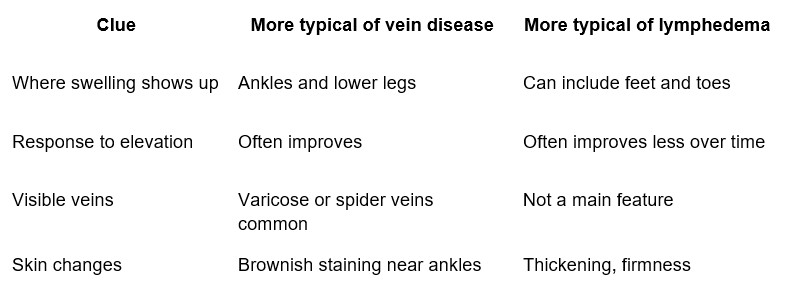
- Swelling around the ankles that improves after a night of sleep or putting the legs up
- Varicose veins (bulging, twisted veins) or spider veins
- Itching, cramping or restless legs at night
- Skin around the ankles that becomes darker, brownish or leathery over time
- In more advanced cases, sores near the ankle that are slow to heal
Risk factors include family history, pregnancy, getting older, carrying extra weight, a past blood clot and jobs that involve long hours of standing or sitting.
Signs That May Point to Lymphedema
Lymphedema is swelling caused by fluid that the lymphatic system cannot clear. Some people are born with lymphatic problems that show up later in life. Others develop it after cancer treatment, lymph node removal, radiation, infection or injury.
Lymphedema often looks a bit different from vein-related swelling:
- Swelling may include the foot and toes, not just the ankle
- It may not go down much with rest or putting the legs up, especially as time goes on
- The leg can feel full, tight or heavy
- The skin may slowly become thicker or firmer
- Repeated skin infections (cellulitis) can happen in the affected leg
Vein problems and lymphatic problems can also overlap. Long-term vein disease can put extra strain on the lymphatic system, so some people have features of both.
Other Reasons Legs Can Swell
Not all leg swelling comes from the veins or lymph system. Swelling in both legs can also be linked to heart, kidney or liver problems, thyroid issues, or side effects from certain medicines. Lipedema, a condition that mostly affects women, causes a buildup of fat in the legs that can look like swelling and is often confused with lymphedema.