

MedFriendly®














Hemiplegia
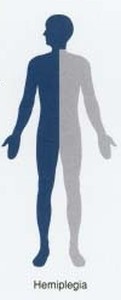
Hemiplegia is total paralysis on one side of the body (arms, legs, and
trunk), meaning that there is a lack of muscle function (movement) on that
side. Hemiplegia can occur on the entire left or right side of the body.
Hemiplegia can also occur on one specific part of the body (such as the
face) on the right or left side.
The most common cause of hemiplegia is stroke, particularly in the elderly.
A stroke is a burst artery (a type of blood vessel that carries blood away
from the heart) or a blockage of an artery in the brain. Other types of brain
damage (such as traumatic brain injury from serious accidents) can also
lead to hemiplegia.
FEATURED BOOK: Spinal Cord Injury: Functional Rehabilitation
Hemiplegia can be caused when there is damage to the corticospinal tract, which are
nerve pathways from the cortex (outermost part of the brain) to the spinal cord. Since the
right motor cortex controls movement on the left side of the body and vice versa,
hemiplegia caused by brain damage is usually the result of brain damage on the opposite
side of the body. In other words, hemiplegia on the right side is usually caused by
damage to the left motor cortex. The motor cortex is an area in the front part of the brain
that plays an important role in motor functioning. Damage to the spinal cord can also
result in hemiplegia. Hemiplegia can be accompanied by loss of sensation as well as
loss of movement if there is damage to areas of the brain or spine that control sensation.
Hemiplegia is different from hemiparesis which is a less severe condition characterized
by weakness on one side of the body as opposed to complete loss of movement.
"Where Medical Information is Easy to Understand"™
The word "hemiplegia," comes from the Greek word "hemi," meaning "half," and the word "plege," meaning
"stroke." Put the two words together and you have "half stroke," referring to half of the body being
affected. Because strokes sometimes lead to loss of movement and/or sensation in parts of the body,
the word "plegia" is used to refer to such conditions. Other types of "plegias" include quadriplegia,
diplegia, and paraplegia.