

MedFriendly®














Suppository
What should a doctor or nurse do if he/she needs to
give a drug to a patient that is vomiting, uncooperative,
has a digestive disorder, or has some other condition
that makes it very difficult to take medication by mouth?
One possible solution is to use a suppository. A
suppository is a small, medicated mass that is shaped
to be readily inserted into another bodily opening
besides the mouth. Suppositories are typically inserted
in the rectum (also known as the rear end), vagina, or
the urethra (the small tube that drains urine from the
bladder).
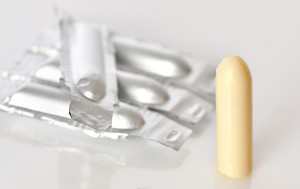
An example of a suppository
for the rectum.
FEATURED BOOK: Complete Guide to Prescription and Non-Prescription Drugs
Suppositories are designed to be solid at regular temperatures, but to melt when
entered into the body.
WHAT DO SUPPOSITORIES LOOK LIKE?
Suppositories are a variety of different shapes depending on which bodily opening they
will enter (see picture above). Suppositories that enter the vagina are shaped like an
egg or a globe. Those that enter the rectum are shaped like a cone or a small bullet.
Those that enter the urethra are shaped like a pencil. Suppositories that enter through
the rectum are absorbed by the entire body, which is why this route is very useful in
babies and the types of patients mentioned in the beginning of this entry that have
difficulty taking medication by mouth.
"Where Medical Information is Easy to Understand"™
WHAT ARE SUPPOSITORIES MADE OF BESIDES MEDICATION?
In order to get into some rather sensitive areas of the body,
suppositories need to be made of something besides medication to
make them enter the body as easily as possible.
An example of an ingredient used in suppositories that helps them
enter the body easily is vegetable oils with hydrogen added to them.
Adding hydrogen to vegetable oils makes them harder and allows
the suppository can be formed into a solid mass.
Other common ingredients for suppositories are cocoa butter, glycerinated gelatin (half of a jello-like
substance known as gelatin and half of an oily fluid called glycerin), mixtures of polyethylene glycols (a
substance with a high molecular weight, made of water and a gas known as ethylene oxide) of various
weights, and certain compounds of polyethylene glycols, known as fatty acid esters. Molecular comes
from the word "molecule." A molecule is a combination of atoms. An atom is the smallest part of a
substance that can exist alone or in combination with something else. See the entry for bisacodyl for an
example of a suppository.
WHAT IS THE ORIGIN OF THE TERM, SUPPOSITORY?
Suppository comes from the Latin word "sub" meaning "under," and the Latin word "ponere" meaning
"place." Put the two words together and you get "place under."